Arabesque Op. 100 No. 2
Friedrich Burgmüller
It started life as a waltz for men's choir: Johann Strauss II had it sung by a Vienna choral society in 1867. The orchestral version became a hit that same year at the Paris World's Fair, and it never left the stage after that. It's still a fixture of Vienna's New Year's Concert, and Stanley Kubrick used it to dock spaceships in 2001: A Space Odyssey.
32 bars · 1 A4 pages
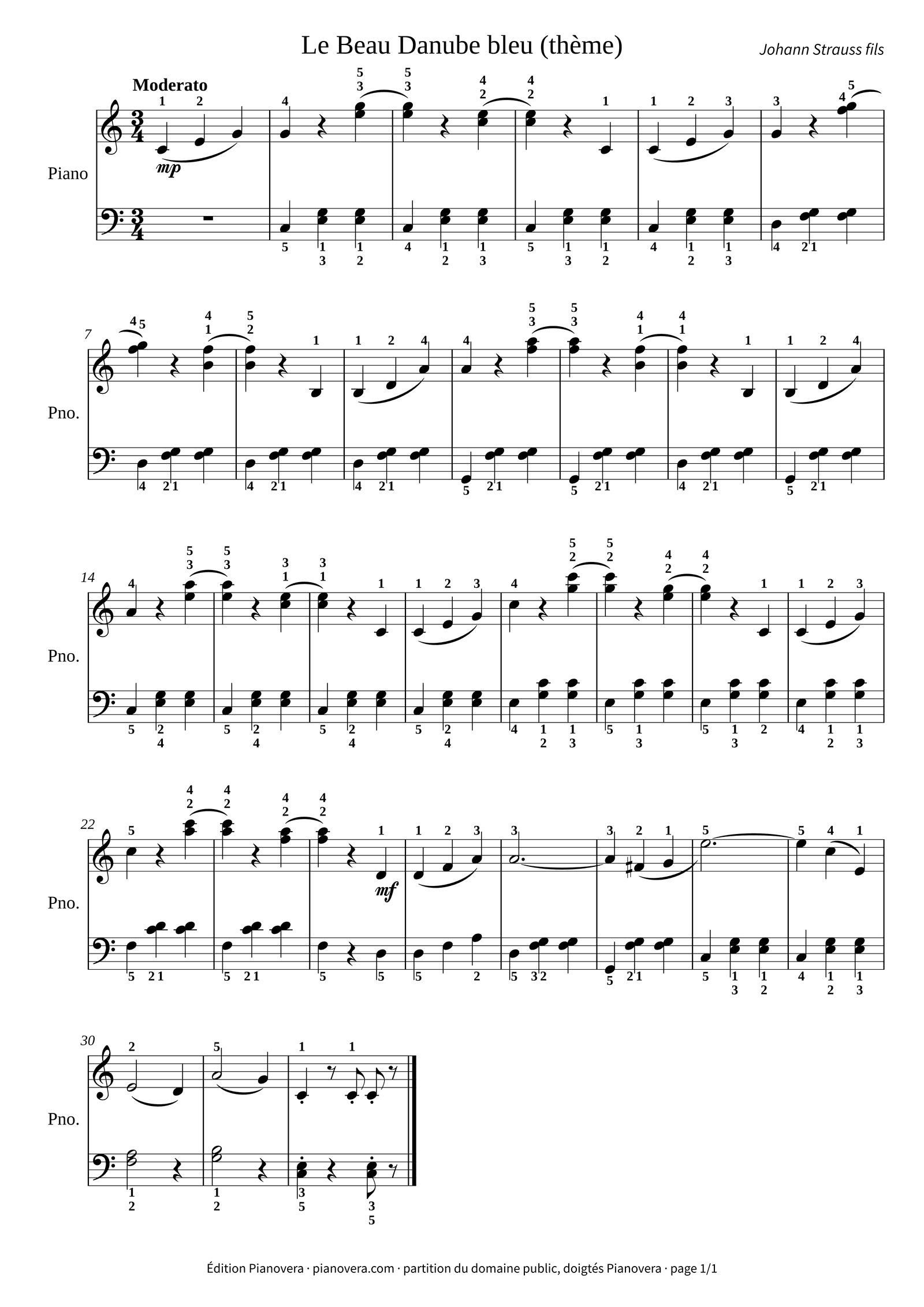
This arrangement keeps what matters: the main theme, moved to C major (the original is in D), over the classic oom-pah-pah bass. The left hand plays a bass note and then 2 chords, the right hand sings the rising arpeggio. No sharps or flats in the key signature, which makes it the most direct way we know to play a real Viennese waltz in your first months.
Right hand, in letter names (C4 = middle C): C4 C4 E4 G4 G4 G5 G5 E5 E5 C4 C4 E4 G4 G4 G5 G5 F5 F5 B3 B3 D4 A4 A4 A5…
No MIDI keyboard? Play The Blue Danube on the virtual piano, with your computer keyboard letters on each note.
Turn on Pianovera's metronome and count "1, 2, 3" out loud while the left hand plays alone. Once the sway feels natural, add the right hand in Wait mode. The piece lasts under a minute, so replay it 5 times in a row, then switch to scored Scrolling to track your progress.
Open The Blue Danube (main theme) in Pianovera: on PC with the falling notes piano software for Windows, on a phone or in your browser.
Free, with no time limit and no ads: 10 pieces in full plus the piece of the week, 30-second excerpts of the others, the first 7 lessons and the 3D hands with no limit. Premium opens all 651 pieces.
The MIDI file lasts 0:56: 32 bars in 3/4, 237 notes, at 114 bpm (quarter notes). Slowed to 60%, it lasts 1:33.
We rate it beginner in C major, with sustain pedal marks. The left hand stretches up to 5 semitones and the right hand up to 6 semitones, across 41 semitones of keyboard (G2 to C6), at 4.2 notes per second on average. The first thing to work on: the waltz bass, with its low note and 2 light chords.
It is bar 3: the busiest bar, with 9 notes across both hands.
Aim for 70 bpm (quarter notes), which is 60% of the file's tempo (114).
Yes: 199 fingerings, 32 bars, shown in full above and as a free printable PDF.
Friedrich Burgmüller
Robert Schumann
Frédéric Chopin
Robert Schumann
Frédéric Chopin
Erik Satie
← Back to the full MIDI library
The The Blue Danube MIDI file (5 KB) is the one this page plays. CC0 1.0 license like the sheet music PDF, free to use, videos included.
The Windows version won’t run on a phone.
Get the Android appFree on Google Play, with no time limit.
Get the iPhone appFree on the App Store, with no time limit.
Play in your browser