Für Elise
Ludwig van Beethoven
Liszt's Consolation No. 3 as a free piano MIDI: four minutes of nocturne to hear in the preview, file and sheet music PDF to download.

Play it with the 3D hands in Pianovera
Green notes: right hand, blue notes: left hand. Preview played right in your browser with the app's real piano (lightweight version). Inside Pianovera: full multi-layer sound, fingering display and Wait mode.
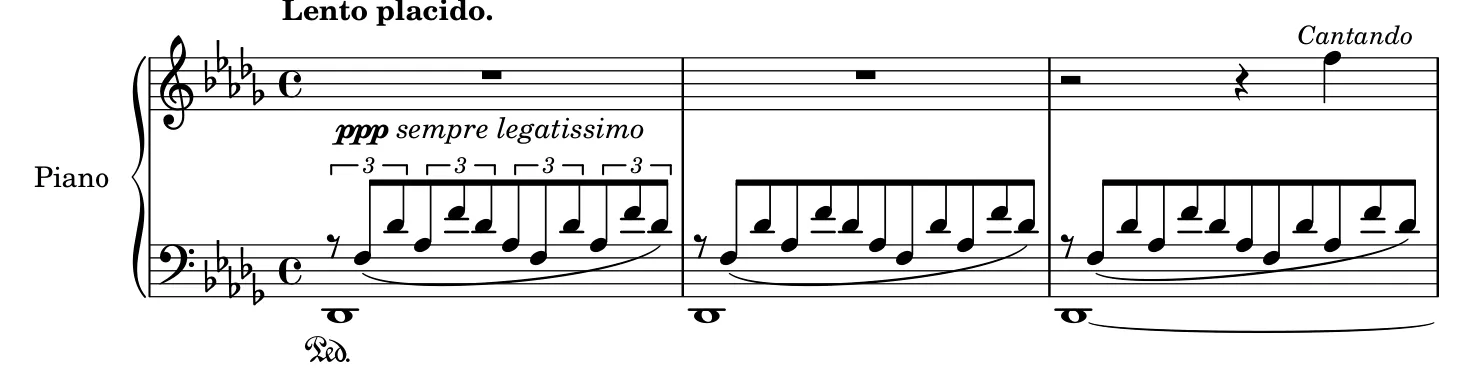
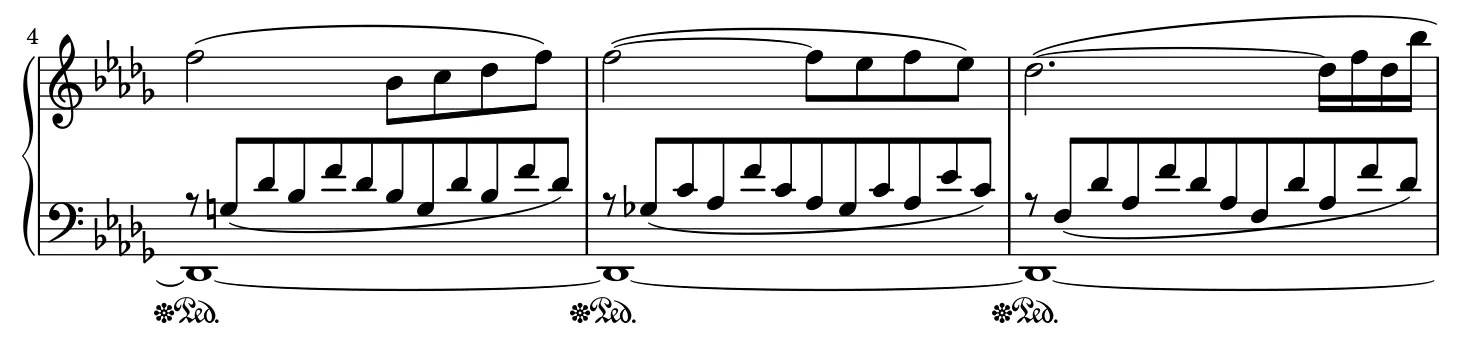
Tap a bar to jump there · engraved by the Mutopia Project.View the whole score (PDF) →
Liszt, the man who made concert halls faint with his octaves, wrote here the exact opposite: a Chopin-style nocturne in D-flat where virtuosity steps aside for song. The third Consolation became the best-loved of the set for precisely that reason, and its MIDI proves it: this is the giant, whispering.
The piece rests on a pedal secret: a deep bass held while the harmony ripples above it, and the melody entering almost late, like a thought. Technically within an intermediate player's reach, it mostly demands sonic patience and an intelligent pedal. The result repays every minute.
Right hand, in letter names (C4 = middle C): F5 F5 A#4 C5 C#5 F5 F5 D#5 F5 D#5 C#5 F5 C#5 A#5 G#5 F5 F5 A#4 C5 C#5 F5 F5 E5 G#5… The rest scrolls in the preview above, with the fingering, and the sheet music PDF has the whole piece.
Here are the Consolation No. 3 in D-flat virtual piano notes, in computer keyboard letters: the first 8 bars of the melody. One key per note, read left to right; dark keys are the sharps, and a thin line marks each bar. The melody sounds an octave lower than written, so it fits on the keyboard.
R R J Q L R
R ; R ; L R L 7
6 R R J Q L R
R E 6 T R 6 R 9
This file carries the original pedal markings: turn sustain on in Pianovera and hear the bass carry the whole phrase. The preview shows the melody entering off the beat; don't straighten it, that lateness is the point.
Open Consolation No. 3 in D-flat in Pianovera: the notes fall toward an 88-key virtual piano keyboard, each hand gets its color, and Wait mode is there if you're starting out. On a PC, it's falling notes piano software for Windows, with video export up to 4K.
Free, with no time limit and no ads: 30 pieces (10 in full, 20 in a simplified version), the first 10 lessons and 10 minutes of 3D hands (then 15 seconds per piece). Premium opens all 651 pieces.
Two files are waiting for you: the Consolation No. 3 in D-flat piano MIDI file (9 KB, opens in Pianovera or any MIDI player) and the Consolation No. 3 in D-flat piano sheet music PDF (229 KB, printable). Both come from the same engraving: what you read on the score is exactly what you hear in the preview.
The work itself is in the public domain. This MIDI engraving comes from the Mutopia Project, typeset by Ryan Prince, under the CC-BY 3.0 license (free reuse with attribution, commercial included).
We rate it intermediate: 1029 notes over 4:03, spanning C2 to F7, with sustain pedal marks. The first thing to work on: the deep pedal bass under moving harmony.
Right on this page: the "View the sheet music" button opens the PDF (229 KB), engraved by the Mutopia Project from the same source as the MIDI file, CC-BY 3.0 license. View it, print it, keep it.
Yes. Franz Liszt died more than 70 years ago, so the work (1850) is public domain. This MIDI engraving is under the CC-BY 3.0 license: free to use, commercially included, with credit to Ryan Prince.
Ludwig van Beethoven
Claude Debussy
Wolfgang Amadeus Mozart
The Windows version won’t run on a phone.
Get the Android appFree on Google Play, with no time limit.
Play in your browser