Für Elise
Ludwig van Beethoven
Debussy's First Arabesque as a piano MIDI: playable preview, free download and sheet music PDF gathered on the same page.

Play it with the 3D hands in Pianovera
Green notes: right hand, blue notes: left hand. Preview played right in your browser with the app's real piano (lightweight version). Inside Pianovera: full multi-layer sound, fingering display and Wait mode.
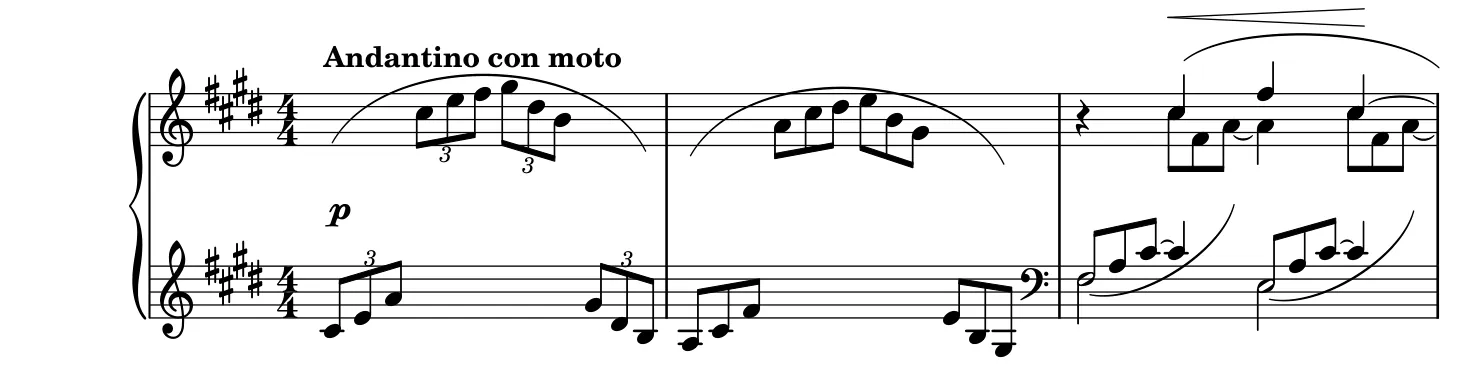
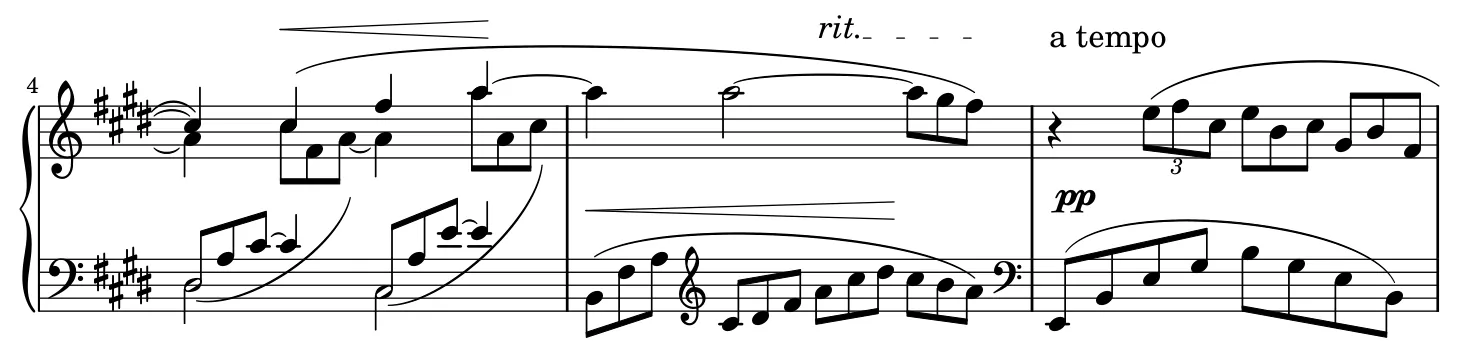
Tap a bar to jump there · engraved by the Mutopia Project.View the whole score (PDF) →
Debussy was 26, years before La Mer and the Préludes, when he wrote the two Arabesques that already announce everything: the First unspools garlands of triplets flowing from hand to hand as if the keyboard itself were rippling. No drama anywhere in this MIDI, just light and curves.
It gently introduces the challenge that returns all over Debussy: two against three. The duple melody has to float above the triplets without being pulled into them. It's more approachable than Clair de Lune, and frankly the best place we know to tame that polyrhythm before going further.
Right hand, in letter names (C4 = middle C): C#4 C#5 E5 F#5 G#5 D#5 B4 B3 A3 A4 C#5 D#5 E5 B4 G#4 G#3 C#5 F#4 A4 F#5 C#5 F#4 A4 C#5… The rest scrolls in the preview above, with the fingering, and the sheet music PDF has the whole piece.
Here are the virtual piano notes for the First Arabesque, in computer keyboard letters: the start of the theme, after the opening arpeggios. One key per note, read left to right; dark keys are the sharps, and a thin line marks each bar. The melody sounds an octave lower than written, so it fits on the keyboard.
L 5 L L 5 Y
Y 6 5 E 5 L E M L H M G
H C H D S
Slow Pianovera down to 60% and watch the grid: the triplets and the duplets draw two visible patterns crossing each other. Seeing the polyrhythm before playing it is exactly what paper scores never give you.
Open Arabesque No. 1 in Pianovera: the notes fall toward an 88-key virtual piano keyboard, each hand gets its color, and Wait mode is there if you're starting out. On a PC, it's falling notes piano software for Windows, with video export up to 4K.
Free, with no time limit and no ads: 30 pieces (10 in full, 20 in a simplified version), the first 10 lessons and 10 minutes of 3D hands (then 15 seconds per piece). Premium opens all 651 pieces.
Two files are waiting for you: the First Arabesque piano MIDI file (13 KB, opens in Pianovera or any MIDI player) and the First Arabesque piano sheet music PDF (131 KB, printable). Both come from the same engraving: what you read on the score is exactly what you hear in the preview.
The work itself is in the public domain, and this MIDI engraving was placed in the public domain by its typesetter on the Mutopia Project. Use it freely, videos included.
We rate it intermediate: 1448 notes over 2:56, spanning E1 to G#6. The first thing to work on: two against three in comfort, without counting out loud.
Right on this page: the "View the sheet music" button opens the PDF (131 KB), engraved by the Mutopia Project from the same source as the MIDI file, Public domain license. View it, print it, keep it.
Yes. Claude Debussy died more than 70 years ago, so the work (1891) is public domain. This MIDI engraving is public domain too: download it and use it freely, videos included.
Ludwig van Beethoven
Claude Debussy
Wolfgang Amadeus Mozart
The Windows version won’t run on a phone.
Get the Android appFree on Google Play, with no time limit.
Play in your browser